 Skip to content


Building a music practice routine in Pasadena does not require an hour of scales every night or a perfectly quiet house. For most kids, the routine that actually works is short, predictable, and easy to repeat around school, homework, sports, and family time.
If your child is taking music lessons in Pasadena, the goal is not to practice as long as possible. It is to make sitting down with the instrument feel like a normal part of the week instead of a negotiation that starts from scratch every day.
Start a Music Practice Routine in Pasadena With a Realistic Time
The best practice time is the one your family can repeat. For some children, that is 15 minutes soon after school. For others, it is a short session after dinner or before an evening activity.
Pasadena families already know how full an after-school schedule can become. Longfellow Magnet, for example, offers students art, music, Spanish, sports, clubs, and other after-school opportunities. When a child has several interests competing for the same afternoon hours, a smaller practice block that happens consistently is usually more useful than an ambitious schedule that disappears after a week.
Start with a time your child can handle without feeling trapped. A younger beginner may do well with 10 to 15 focused minutes. As attention and skills grow, the routine can grow too.
Make the Instrument Easy to Start
A surprisingly large part of practice is simply getting started. If the instrument is packed away, the music is missing, or the child has to clear a space every time, practice already feels like work before the first note.
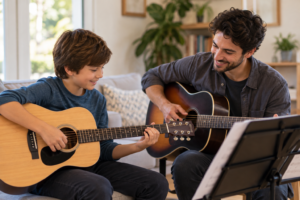
This is one reason our in-home lesson format can be helpful. The teacher sees the same room, instrument, bench, music stand, and setup the student uses during the rest of the week. That makes it easier to solve practical problems that might otherwise go unnoticed.
For families in residential areas such as Bungalow Heaven, where the City of Pasadena recognizes a historic neighborhood filled largely with Craftsman bungalows, a dedicated music room is not necessary. A consistent corner of a living room or bedroom can work perfectly well if the instrument is accessible and the student knows where the music and supplies belong.
For piano students especially, our piano instruction can help families think through details such as bench position, lighting, music placement, and what the child should work on between lessons.
Give Kids a Specific Job, Not Just “Go Practice”
Telling a child to “practice piano” or “practice guitar” is vague. A better routine gives them something concrete to finish.
Instead of measuring every session only by minutes, the assignment might be: play the difficult four measures slowly five times, practice two chord changes without stopping, clap the rhythm before playing it, or play one section with each hand separately.
Specific goals make progress easier for kids to recognize. They also give parents a better question to ask. Instead of “Did you practice?” you can ask, “How did those four measures go today?”
That shift matters because effective practice is not just repetition. It is learning how to notice a problem, work on it deliberately, and hear the improvement.
Use Pasadena’s Music Community as Motivation
Practice becomes easier to understand when children can see what music looks like beyond their own lesson.
Pasadena has several ways for families to make that connection. Longfellow Magnet partners with the Pasadena Conservatory of Music, giving TK–5 students weekly music experiences that can include percussion, strings, choir, or keyboard. The Pasadena Playhouse also runs youth programs where children work with music, movement, acting, and live performance.
Even a child who has no interest in musical theater can benefit from seeing other young people rehearse and perform. It helps connect the small work happening at home with something larger: making music with other people, performing for an audience, or simply becoming confident enough to play a favorite song for family.
That is also part of why music lessons matter. Practice has more meaning when the student understands what the skill can eventually allow them to do.
What to Do When Your Child Does Not Want to Practice
Every student has days when they would rather do something else. One reluctant afternoon does not mean the routine has failed.
First, check whether the assignment is clear. Children often avoid practice when they do not remember what they are supposed to do. Next, reduce the size of the task. Ten focused minutes can preserve the habit on a difficult day without turning music into a fight.
If resistance becomes a pattern, tell the teacher. The student may need a different piece, a smaller goal, or a new way of approaching a difficult skill. A good teacher can adjust the challenge without removing the expectation that progress takes effort.
Parents do not need to become the music teacher at home. Your job is to protect the routine, encourage effort, and let the instructor handle the technical corrections.
A Simple Practice Checklist for Pasadena Families
Before deciding that your child needs to practice more, check whether the routine itself is working:
- Is practice happening at roughly the same time on most practice days?
- Can your child explain what the teacher asked them to work on?
- Is the instrument easy to access and ready to use?
- Are practice sessions short enough for your child’s current attention span?
- Does your child have one or two specific goals instead of a vague assignment?
- Can you see or hear small improvements from week to week?
Build a Routine Your Family Can Actually Keep
A successful music practice routine in Pasadena should fit your real family life, not an imaginary schedule where nothing runs late and children are always eager to practice. Consistency matters, but consistency can be simple.
In Home Music Mentor helps students build those habits through personalized lessons in the environment where they practice every week. Families looking for Pasadena in-home music lessons can work with a teacher who understands both the musical goals and the practical routine needed between lessons.
If you are ready to see what that can look like for your child, claim your 50% off trial lesson and start with a routine that is designed to grow with them.