 Skip to content
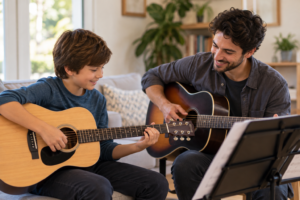


When families first sign up for music lessons, the goal is often simple: learn an instrument, explore creativity, or give a child a fun extracurricular activity. But over time, many parents notice something much bigger happening. Music lessons begin shaping routines, habits, focus, confidence, and discipline in ways that reach far beyond music itself.
At In Home Music Mentor, we regularly see students develop stronger study habits, better patience, improved confidence, and more independence through consistent music education. Whether students are learning piano, guitar, voice, bass guitar, songwriting, or beginner music fundamentals, the weekly structure of lessons often becomes one of the healthiest parts of a student’s routine.
Families searching for music lessons in Kirkland, music lessons in Madison, music lessons in Portland, music lessons in Missoula, music lessons in Provo, and music lessons in Bellingham often discover that the benefits of music reach far beyond learning songs.
Music lessons naturally create routine
Children thrive on consistency. Weekly lessons create a dependable rhythm that students can count on. They begin understanding responsibility, preparation, and how small actions repeated over time create improvement.
Even practicing for short periods each week can help students build healthy long-term habits. Music teaches students how to organize their time, focus on one task at a time, and work steadily toward a goal.
This is one reason why many parents continue lessons year after year. Music becomes more than entertainment. It becomes part of a balanced lifestyle.
Students learn patience through repetition
Learning music takes time. Students rarely master a song immediately. Instead, they improve through repetition, problem-solving, and consistency.
That process teaches patience in a natural way. A student learns that difficult things become easier when they stay committed and continue practicing.
In piano lessons, students often practice hand coordination, rhythm reading, and note recognition repeatedly until the music begins flowing naturally. In guitar lessons, students may slowly strengthen finger coordination while learning chord transitions and rhythm patterns.
Those experiences teach students something important: progress does not need to happen instantly to be meaningful.
Music helps students become more confident learners
Confidence is built through experience. Every time a student learns a new rhythm, masters a song, or improves a difficult section, they gain evidence that they are capable of growth.
That confidence often transfers into school, sports, and other activities. Students begin understanding that mistakes are part of learning rather than signs of failure.
Music lessons provide a safe environment to practice perseverance. A supportive teacher can encourage students through challenges while helping them celebrate progress along the way.
Families can explore our music mentors to find instructors who match different personalities, learning styles, and goals.
Learning at home creates a more relaxed environment
Some students feel intimidated in traditional studio settings. Learning at home can remove much of that pressure.
With In Home music lessons, students can learn in a familiar environment where they already feel comfortable. This often helps students focus more naturally and participate more openly during lessons.
Parents also appreciate the convenience. Instead of driving across town after work or school, families can build music lessons directly into their weekly routine.
Music supports creativity in a structured way
One of the most unique things about music education is the balance between structure and creativity. Students learn technique, rhythm, and music theory while also expressing emotion and personality through sound.
Some students enjoy classical piano pieces. Others become interested in pop songs, improvisation, songwriting, or recording. Music gives students space to explore creativity while still developing discipline and focus.
Teachers like David B and Jada bring different creative strengths and teaching styles that help students stay engaged and inspired.
Healthy habits are easier when students enjoy the process
One reason music lessons are so effective for personal growth is because students genuinely enjoy them. Healthy habits become easier to maintain when students feel emotionally connected to the activity.
A student who enjoys practicing a favorite song is also practicing focus, patience, and consistency at the same time.
This positive relationship with learning can help students develop healthier attitudes toward growth overall.
Local music culture helps inspire students
Many cities served by In Home Music Mentor have vibrant music communities that inspire young musicians. Universities, local venues, arts organizations, and community programs all help students see music as something meaningful and lasting.
Students in Washington may look toward programs like the University of Washington School of Music or the Western Washington University Department of Music.
Students in Oregon may become inspired by the University of Oregon School of Music and Dance, while students in Utah can look toward the BYU School of Music.
These institutions remind students that music can remain part of life long after childhood lessons end.
Supporting families across local neighborhoods
In Home Music Mentor works with students across many neighborhoods and communities.
In Kirkland, families in Juanita, Houghton, Rose Hill, Finn Hill, Norkirk, Totem Lake, and Moss Bay often appreciate lessons that fit around busy Eastside schedules.
In Madison, students in Nakoma, Shorewood Hills, University Heights, Monroe Street, and West Madison can enjoy personalized lessons without extra commuting stress.
In Portland, neighborhoods like Alberta Arts, Hawthorne, Laurelhurst, Pearl District, Sellwood, and St. Johns continue supporting creative learning and music culture.
In Missoula, students throughout Rattlesnake, South Hills, University District, and Downtown Missoula can build music into their weekly routines.
In Provo, families across Joaquin, Maeser, Edgemont, and Rivergrove benefit from convenient lessons that fit naturally into student schedules.
In Bellingham, students throughout Fairhaven, Sunnyland, Columbia, Barkley, and South Hill continue exploring music in comfortable home environments.
Music lessons can support students for years
Some students begin lessons very young and continue for years. Others start later after discovering a new interest in music. Both paths can be valuable.
The long-term benefits of music education often include stronger discipline, creativity, emotional expression, patience, and confidence.
Even students who never pursue music professionally still carry those skills into adulthood.
Final thoughts
Music lessons help students build much more than musical ability. They help create healthy routines, stronger focus, confidence, creativity, patience, and independence.
At In Home Music Mentor, lessons are designed to support students in a way that feels encouraging, flexible, and personal.
If your family is ready to get started, visit the registration page, explore piano lessons, learn more about guitar lessons, or browse local city pages for Kirkland, Madison, Portland, Missoula, Provo, and Bellingham.