 Skip to content
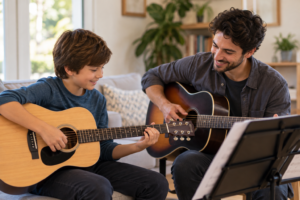

When more than one child in a family becomes interested in music, parents often face an exciting but practical question: Can siblings take music lessons together?
For many families, the answer is yes. Siblings can absolutely learn music during the same weekly visit, and in some cases they may even share part of a lesson. However, the best arrangement depends on their ages, instruments, personalities, attention spans, and individual goals.
At In Home Music Mentor, we help families create personalized lesson plans that make music education practical, enjoyable, and rewarding for every student. With thoughtful scheduling and the right instructor, music lessons can become an activity that brings siblings together while still allowing each child to grow independently.
Why Families Consider Music Lessons for Multiple Children
Parents often begin searching for music lessons after one child shows interest in an instrument. Then a younger sibling starts copying them, an older sibling asks to learn a different instrument, or both children decide they want to participate.
This can be a wonderful development. Music gives siblings a shared interest, creates opportunities for collaboration, and can bring more creativity into the home.
At the same time, parents may worry about managing separate lesson locations, different schedules, transportation, practice time, and costs. These concerns are especially common for families already balancing school, sports, homework, work schedules, and other weekly responsibilities.
Personalized In Home music lessons can make the process much easier because the instructor comes directly to the family.
Can Siblings Share the Same Music Lesson?
Siblings may be able to share a lesson when they are close in age, interested in the same instrument, and working at similar skill levels.
For example, two beginners learning basic rhythm, note names, or simple melodies may enjoy participating together. They can listen to one another, practice musical games, and experience the excitement of learning their first songs as a team.
However, shared lessons are not always the best choice.
If one sibling progresses more quickly, has significantly different goals, or needs a different teaching style, separate instruction may help both students receive the attention they need.
A good music teacher can observe how the children interact and recommend whether they should learn together, separately, or through a combination of both approaches.
Back-to-Back Lessons Are Often the Best Solution
For many families, back-to-back private lessons offer the ideal balance.
Each child receives individual attention, but the family only needs to reserve one block of time. One sibling can complete homework, eat a snack, practice, or relax while the other takes a lesson.
This arrangement allows the teacher to personalize the material for each student. One child may be working on beginner exercises while another explores more advanced songs, technique, theory, or performance skills.
Parents also avoid coordinating separate drives to different studios or waiting in multiple locations throughout the week.
What If Siblings Want to Learn Different Instruments?
Siblings do not need to choose the same instrument to benefit from lessons during the same visit.
One child may be interested in piano lessons while another prefers guitar lessons. Other students may be drawn to voice, violin, drums, ukulele, songwriting, or music theory.
Depending on the instructor’s experience, one teacher may be able to teach multiple instruments during the same visit. In other situations, the family may be matched with different teachers whose schedules can be coordinated as conveniently as possible.
The most important goal is not to make every child follow the same path. It is to help each student find an instrument and learning experience that keeps them engaged.
Learning Music Together Can Strengthen Sibling Relationships
Siblings naturally compete in many areas of life, but music can also teach them how to cooperate.
They may practice a duet, take turns accompanying one another, perform for relatives, or encourage each other before a recital. Even when they learn different instruments, they can still create music together.
A piano student may provide chords while a sibling sings. A guitar student may learn a song that another child plays on keyboard. An older sibling may help a younger beginner remember a rhythm or note.
These shared experiences can create positive family memories while teaching patience, listening, communication, and teamwork.
Healthy Competition Can Be Motivating
A small amount of friendly competition can sometimes encourage siblings to practice.
When one child learns a new song, the other may feel inspired to work toward their own goal. Seeing a sibling improve makes musical progress feel visible and achievable.
However, parents and teachers should be careful not to compare children too closely.
Every student develops at a different pace. One child may learn songs quickly by ear, while another may be stronger at reading music. One may love performing, while another prefers playing quietly for personal enjoyment.
The goal is to celebrate individual progress rather than deciding who is the “better” musician.
Each Child Still Needs Their Own Goals
Even when siblings study with the same teacher, their lessons should reflect their individual interests.
One student may want to play classical music. Another may prefer pop, jazz, musical theater, video game music, or songwriting. One child may dream of performing, while another simply wants a creative hobby.
Personal goals help students feel ownership over their learning.
A strong teacher will build foundational skills while also including music that feels personally meaningful to the student. This balance makes lessons more engaging and gives each sibling something that belongs to them.
How Parents Can Support More Than One Music Student
Supporting multiple children does not mean parents need to supervise every practice session.
Small routines can make a meaningful difference. Families may designate a consistent practice time, create separate folders for each student’s materials, or set up a comfortable area where instruments remain accessible.
Parents can also ask each child what they worked on during the lesson and invite them to share a song when they feel ready.
Encouragement is usually more effective than constant correction. Simple comments such as “I can hear how much smoother that sounds” or “You worked hard on that section” help children recognize their own progress.
Should Siblings Practice at the Same Time?
Practicing together can work well for some families, especially when siblings enjoy playing duets or musical games.
Other families may need separate practice times to reduce noise, distraction, or competition. This is especially helpful when both students are learning loud instruments or need quiet concentration.
The best practice routine is one the family can maintain consistently.
Short, focused practice sessions are often more effective than forcing children to sit with an instrument for a long period. A teacher can recommend realistic practice expectations based on each student’s age and experience.
In Home Lessons Simplify the Family Schedule
Convenience is one of the biggest benefits of arranging music lessons at home.
Instead of loading multiple children into the car, driving across town, waiting through lessons, and rushing home for dinner or homework, families can remain in their own space.
Parents may prepare dinner, help another child with homework, or complete household tasks while staying nearby during the lesson.
Students also learn on the same instrument they use for practice. This allows the teacher to help with the family’s actual piano, keyboard, guitar, or learning setup rather than an instrument found only in a studio.
For busy families, removing the commute can make the difference between trying lessons temporarily and maintaining them consistently.
The Right Teacher Helps Every Sibling Feel Seen
Teaching siblings requires more than musical knowledge. It also requires sensitivity to different personalities and family dynamics.
One child may be outgoing and eager to demonstrate everything they know. Another may need more time before feeling comfortable. One may enjoy challenges, while another responds better to steady encouragement.
The right instructor recognizes these differences and avoids treating siblings as identical students.
Families can learn more about our instructors by exploring our music mentors. Teacher profiles help parents understand each instructor’s background, instruments, teaching philosophy, and approach to working with different types of students.
Music Can Become a Family Activity
When multiple children learn instruments, music often begins spreading throughout the household.
Siblings may play together. Parents may dust off an old instrument. Family members may sing during practice or request favorite songs. Grandparents may look forward to hearing what the children have learned.
Music does not need to remain a private weekly appointment. It can become part of holidays, family gatherings, birthdays, and ordinary evenings at home.
These experiences help children see that music is more than an assignment. It is a way to communicate, celebrate, create, and connect with other people.
Serving Families Across Our Growing Music Communities
Families searching for convenient instruction can explore music lessons in Kirkland, music lessons in Madison, music lessons in Missoula, music lessons in Portland, music lessons in Provo, and music lessons in Bellingham.
We also support students through music lessons in Bend, music lessons in Boise, music lessons in Boulder, music lessons in Fort Collins, and music lessons in Naperville.
Families can also find personalized instruction through music lessons in San Diego, music lessons in San Jose, music lessons in Santa Clara, and music lessons in Raleigh.
Our teachers work with families in neighborhoods including Juanita, Rose Hill, Houghton, Finn Hill, Totem Lake, Moss Bay, Nakoma, Shorewood Hills, University Heights, Monroe Street, Downtown Missoula, South Hills, Alberta Arts, Hawthorne, Laurelhurst, Sellwood-Moreland, the Pearl District, St. Johns, Joaquin, Maeser, Fairhaven, Sunnyland, Columbia, Sehome, Barkley, South Hill, North End Boise, Downtown Boise, River West, Old Bend, Table Mesa, North Boulder, South Boulder, Old Town Fort Collins, Rigden Farm, Downtown Naperville, La Jolla, Carmel Valley, Willow Glen, Rivermark, North Raleigh, and surrounding communities.
Music Education Can Grow With the Entire Family
A child’s first private lesson may eventually lead to school band, choir, orchestra, theater, songwriting, performance, or advanced music study.
Music communities and institutions such as the University of Washington School of Music, University of Wisconsin-Madison Mead Witter School of Music, University of Montana School of Music, University of Oregon School of Music and Dance, and the BYU School of Music demonstrate the many paths available to students who continue developing their musical interests.
Not every student will pursue music professionally, and that does not make the experience any less valuable. The creativity, persistence, coordination, confidence, and listening skills developed through music can benefit children throughout their lives.
Should Your Children Begin Music Lessons Together?
If multiple children in your household are interested in music, you do not necessarily need to choose which child gets to begin first.
Siblings can share part of a lesson, take private lessons back-to-back, study different instruments, or work with separate instructors. The best arrangement depends on the students and the family’s schedule.
What matters most is creating an environment where each child feels encouraged, challenged, and free to develop their own musical identity.
At In Home Music Mentor, we help families find personalized options that work for real home schedules.
Ready to explore music lessons for one child, multiple siblings, or even the whole family? Visit our registration page and tell us about your students, instruments, goals, and availability. We will help you take the next step toward bringing music into your home.
“`