 Skip to content

The beginning of a new school year brings fresh notebooks, new teachers, changing schedules, and plenty of excitement. It also brings an important question for parents: What activities will help my child feel confident, balanced, and motivated this year?
Between homework, sports, clubs, and family responsibilities, it can be difficult to choose an extracurricular activity that feels meaningful without making the week more stressful.
That is where music lessons can make a lasting difference.
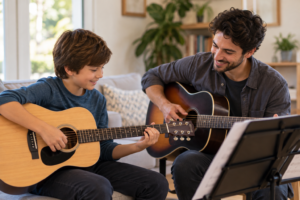
At In Home Music Mentor, we help families build music into their weekly routines through personalized instruction that takes place in the comfort of home. Students can develop confidence, focus, creativity, and discipline while learning an instrument they genuinely enjoy.
Why the Beginning of the School Year Is a Great Time to Start
The start of a new school year naturally encourages families to create routines.
Bedtimes become more consistent. Homework schedules return. Families begin organizing transportation, meals, activities, and weekly commitments.
Adding music lessons during this period can help the activity become part of the family’s normal rhythm rather than something squeezed into an already established schedule later in the year.
When students know that their lesson happens on the same day each week, music becomes something familiar and dependable. They begin to understand when to practice, what they are working toward, and how their musical goals fit alongside school responsibilities.
Music Gives Students Something Positive to Anticipate
The school year can be demanding, especially when children are adjusting to new classrooms, expectations, teachers, and social situations.
A weekly music lesson can become a positive break from those pressures.
Students are still learning, but music feels different from a traditional academic subject. They can explore songs they enjoy, express themselves creatively, and experience progress in a way they can immediately hear.
A child taking piano lessons may feel proud after playing a melody smoothly for the first time. A student enrolled in guitar lessons may become motivated by learning the chords to a favorite song.
Those moments can give students something exciting to look forward to throughout the week.
Music Lessons Can Support Better Focus
Children are surrounded by distractions. Notifications, videos, games, and social media compete for their attention every day.
Learning music encourages students to slow down and focus on one task at a time.
They listen carefully, follow patterns, read notes, coordinate movements, and repeat difficult sections until they improve. These habits require patience and concentration.
Over time, students begin to understand that focused effort produces results. That lesson can support them not only during music practice but also during homework, reading, test preparation, and other school responsibilities.
A Healthy Activity After a Long School Day
After spending hours in the classroom, many students come home tired and immediately reach for a screen.
There is nothing wrong with taking time to relax, but passive screen time can quickly fill the entire afternoon or evening.
Music gives children another way to unwind.
Playing an instrument engages the mind and body while providing a creative outlet. Students can process the day through sound, rhythm, and movement instead of simply consuming more digital content.
Music lessons do not need to eliminate screen time completely. They simply provide a healthier balance and give children something meaningful to create.
In Home Lessons Reduce Family Stress
Parents already spend a significant amount of time driving children to school, practices, games, appointments, and activities.
Adding another weekly commute can make even a valuable extracurricular activity difficult to maintain.
With In Home music lessons, the teacher travels directly to the student. Families avoid the rush across town, waiting-room time, and the stress of coordinating another pickup and drop-off.
Students also learn in a familiar environment where they may feel more comfortable asking questions, making mistakes, and trying again.
For parents, the convenience can make it much easier to keep lessons consistent throughout the school year.
Consistency Helps Children Build Confidence
Confidence develops through repeated experiences of progress.
A student may struggle with a rhythm during one lesson. They practice it during the week, receive guidance at the next lesson, and eventually play it successfully.
That achievement may seem small, but it teaches an important lesson: challenges can become manageable through patience and effort.
As students collect these small victories, they begin to see themselves differently. They become more willing to try difficult things, recover from mistakes, and continue working even when improvement takes time.
These qualities can benefit children in the classroom, during sports, and throughout everyday life.
The Right Teacher Keeps Students Motivated
A great music teacher does much more than teach notes, scales, and technique.
The right teacher understands how to connect with the student. They know when to offer a challenge, when to slow down, and how to make lessons engaging without losing structure.
Some students enjoy clear goals and step-by-step instruction. Others respond better to creativity, humor, movement, improvisation, or learning songs they already know.
Families can explore our music mentors to learn more about the teaching backgrounds, instruments, personalities, and experiences available through In Home Music Mentor.
Teacher profiles such as David B and Jada help families understand how different instructors bring their own musical strengths and teaching approaches into each lesson.
How Much Should a Child Practice During the School Year?
Parents sometimes worry that music practice will create another source of conflict or pressure.
Practice does not need to be long or overwhelming to be effective.
For many beginners, short and consistent practice sessions are more valuable than one long session immediately before the next lesson. A teacher may recommend several focused minutes each day based on the student’s age, goals, and experience level.
The best routine is one the family can realistically maintain.
Students may practice after a snack, before dinner, or after completing homework. Keeping the instrument visible and accessible can also make practice feel more natural.
Music Teaches Time Management Without Feeling Like a Chore
As children balance school and activities, they begin learning how to manage their time.
Music provides a practical way to develop this skill.
A student learns that waiting until the final evening before a lesson makes progress more difficult. Practicing in small amounts throughout the week feels easier and produces better results.
This experience helps students understand planning, responsibility, and preparation in a positive setting.
Unlike an assignment completed only for a grade, musical progress gives students a reward they can hear. A song begins sounding smoother, a chord becomes easier, and a difficult section finally feels comfortable.
Music Lessons Can Grow With Your Child
A beginner’s goals may be simple: learn basic notes, play a favorite song, or become comfortable with an instrument.
As the student develops, those goals can change.
They may become interested in songwriting, performance, improvisation, music theory, school ensembles, recording, or learning a second instrument.
This flexibility makes music a valuable long-term activity. Lessons can continue adapting as the student’s age, personality, and musical interests evolve.
Music Can Support Social and Emotional Growth
Music gives children another way to express themselves.
Not every student finds it easy to explain how they feel. Playing, singing, or writing music can provide a creative outlet when words are difficult.
Students may also become more comfortable performing for family members, participating in school music programs, or collaborating with other young musicians.
These experiences can strengthen communication, confidence, listening skills, and the ability to work with others.
Connecting Students With a Larger Music Community
Private music lessons can be the beginning of a much larger creative journey.
Students may become interested in school band, orchestra, choir, musical theater, local performances, community ensembles, or advanced music programs.
Respected institutions such as the University of Washington School of Music, University of Wisconsin-Madison Mead Witter School of Music, University of Montana School of Music, University of Oregon School of Music and Dance, BYU School of Music, and Western Washington University Department of Music demonstrate how musical learning can continue from childhood into higher education and adulthood.
Not every child needs to pursue music professionally. The confidence, creativity, discipline, and enjoyment developed through lessons remain valuable regardless of the path they choose.
Serving Families Across Our Music Communities
Families looking for personalized back-to-school instruction can explore music lessons in Kirkland, music lessons in Madison, music lessons in Missoula, music lessons in Portland, music lessons in Provo, and music lessons in Bellingham.
We also provide personalized instruction through music lessons in Bend, music lessons in Boise, music lessons in Boulder, music lessons in Fort Collins, and music lessons in Naperville.
Families can also find local teachers through music lessons in San Diego, music lessons in San Jose, music lessons in Santa Clara, and music lessons in Raleigh.
Our teachers serve families throughout Juanita, Rose Hill, Houghton, Finn Hill, Norkirk, Totem Lake, Moss Bay, Nakoma, Shorewood Hills, University Heights, Monroe Street, Rattlesnake, South Hills, the University District, Downtown Missoula, Alberta Arts, Hawthorne, Laurelhurst, Sellwood-Moreland, the Pearl District, St. Johns, Joaquin, Maeser, Edgemont, Rivergrove, Fairhaven, Sunnyland, Columbia, Sehome, Barkley, South Hill, North End Boise, Downtown Boise, River West, Old Bend, Table Mesa, North Boulder, South Boulder, Old Town Fort Collins, Rigden Farm, Downtown Naperville, La Jolla, Carmel Valley, Willow Glen, Rivermark, North Raleigh, and surrounding communities.
Start the School Year With a Skill That Lasts
A new school year gives children an opportunity to grow, discover new interests, and develop habits that support them for years.
Music lessons combine creativity with structure. They help students focus, build confidence, express themselves, and experience the satisfaction of steady progress.
With personalized instruction at home, families can enjoy these benefits without adding another stressful commute to the weekly schedule.
At In Home Music Mentor, we help students find teachers who understand their interests, personalities, and goals.
Ready to make music part of your family’s back-to-school routine? Visit our registration page and tell us about your student. We will help match your family with a music mentor who can make learning convenient, personal, and rewarding.
“`