 Skip to content

Every parent wants their child to become more independent.
We want children to remember their responsibilities, solve problems without immediately giving up, manage their time, and gradually become confident making decisions on their own.
But independence is not something children suddenly develop when they become teenagers or leave home. It grows through hundreds of small experiences.
Music lessons can provide many of those experiences.
At In Home Music Mentor, students learn much more than notes and songs. Personalized music instruction gives children opportunities to take ownership of a skill, prepare for weekly goals, work through challenges, and recognize that their own effort directly affects their progress.
Those lessons can become valuable far beyond the practice room.
Music Gives Children Something That Belongs to Them
Children spend much of their day following instructions created by adults.
They complete assignments chosen by teachers, follow household routines established by parents, and participate in activities with specific expectations.
Music can feel different.
Although a teacher provides guidance, the student gradually begins developing a musical identity of their own.
They may choose which song they want to learn next. They may decide how they want a piece to sound. They may discover that they prefer classical music, pop, jazz, film scores, rock, songwriting, or improvisation.
Those choices give students a sense of ownership.
Instead of simply completing another assignment, they begin thinking, “This is something I am learning for myself.”
Weekly Lessons Teach Students to Prepare
A music lesson happens on a schedule.
The student knows their teacher will return next week and that there will be something to continue working on.
This creates a natural opportunity to learn preparation.
Students begin understanding that what happens between lessons matters. Practicing a little throughout the week usually makes the next lesson easier and more enjoyable.
Over time, they may begin remembering their music books, organizing their practice materials, reviewing assignments, and keeping track of what they are supposed to work on.
These may seem like small responsibilities, but they are exactly how independence develops.
Children Learn That Progress Depends on Their Own Effort
One of the most powerful lessons music teaches is that improvement is connected to action.
If a student practices a difficult passage regularly, it usually becomes easier.
If they avoid it, it often remains difficult.
The connection is immediate and easy to understand.
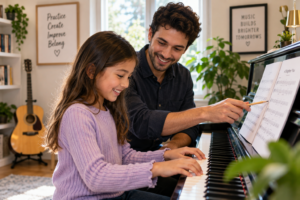
A student taking piano lessons may notice that a section that once required intense concentration becomes comfortable after several days of practice.
A student taking guitar lessons may struggle with a chord transition at first and then suddenly realize they can play it smoothly.
That experience teaches children something important: their choices influence their progress.
Music Encourages Problem-Solving Instead of Immediate Rescue
When children encounter something difficult, their first instinct may be to ask an adult for the answer.
Music encourages a different process.
A note sounds wrong.
The student checks the music.
A rhythm feels awkward.
They slow it down.
A chord is buzzing.
They adjust their fingers and try again.
The teacher still provides support, but students gradually learn how to diagnose small problems themselves.
They begin asking, “What can I change?” instead of immediately assuming they cannot do it.
That problem-solving mindset can become useful in academics, sports, work, and everyday decision-making.
Practice Helps Children Learn Time Management
Children are not born knowing how to manage a schedule.
They learn through experience.
Music gives students a manageable responsibility they can practice balancing with school, homework, sports, friends, and family activities.
A child quickly learns that waiting until five minutes before the next lesson is not the easiest way to improve.
Practicing for shorter periods throughout the week often feels much more manageable.
This teaches students how larger goals can be divided into smaller actions.
Instead of thinking, “I need to master this entire song,” they learn to think, “Today I can work on these eight measures.”
In Home Lessons Can Help Students Take More Ownership
Learning in the student’s own environment can make responsibility feel more natural.
With In Home music lessons, students use the same instrument during their lesson that they use throughout the week.
The teacher can help them organize the actual practice space, troubleshoot their instrument setup, and build habits around the environment where learning really happens.
When the lesson ends, everything remains within reach.
The student does not need to mentally separate “the studio” from “home practice.” Music becomes part of everyday life.
Parents Can Gradually Step Back
When children first begin music lessons, parents may need to provide reminders.
That is completely normal.
A young beginner may need help remembering practice time, locating a music book, or understanding an assignment.
But over time, the goal can be to gradually transfer more responsibility to the student.
Instead of saying, “Go practice now,” a parent might ask, “When are you planning to practice today?”
Instead of checking every assignment, parents can ask the student to explain what their teacher wants them to work on.
These small changes encourage the child to become an active participant in managing their own learning.
Learning an Instrument Teaches Patience
Independence does not mean being able to do everything immediately.
It also means learning how to continue when something takes time.
Music makes this lesson unavoidable.
Some skills take days. Others take weeks or months.
A student may understand exactly what they want their hands to do and still need repetition before the movement feels natural.
This can be frustrating, but it also teaches patience.
Students discover that not every problem has an instant solution and that improvement can happen gradually.
The Right Teacher Encourages Students to Think for Themselves
A strong music teacher does not simply provide every answer.
They help students learn how to think.
A teacher may ask, “What did you notice about that section?” or “What do you think would make this easier?”
Questions like these encourage students to listen critically and make decisions.
Over time, students begin developing their own musical judgment.
Families can explore our music mentors to learn more about the different instructors who help students grow through personalized, one-on-one teaching.
Children Learn How to Set Goals
Music provides endless opportunities for goal-setting.
A beginner may want to play their first complete song.
An intermediate student may want to improve a difficult technique.
A teenager may want to perform, audition for an ensemble, write original music, or record a song.
Good teachers help students turn larger ambitions into smaller achievable steps.
This teaches children how goals actually work.
They learn that wanting something is only the beginning. Progress usually requires planning, repetition, feedback, and adjustment.
Performing Can Build Personal Accountability
Some students eventually choose to perform for family members, participate in recitals, join school ensembles, or play with other musicians.
Performance adds another level of responsibility.
When students know someone else is depending on them, preparation feels more meaningful.
They learn to arrive ready, remember their part, recover from mistakes, and keep going even when they feel nervous.
These experiences can help students become more dependable in other areas of their lives too.
Music Helps Students Become Comfortable Making Decisions
As students progress, music becomes less about simply playing the correct notes.
They begin making artistic decisions.
Should this section be softer?
Should the tempo change slightly?
How should the phrase feel?
What song should they learn next?
These questions do not always have one correct answer.
Students learn to listen, consider options, make a choice, and trust their judgment.
That experience can be especially valuable for children who often worry about making the “wrong” decision.
Responsibility Does Not Mean Taking the Fun Out of Music
Parents sometimes hear words like discipline and responsibility and imagine music becoming another chore.
It should not.
The best learning often happens when responsibility and enjoyment work together.
A student can learn how to practice consistently while still playing songs they love. They can develop technique while exploring music that excites them.
Responsibility becomes meaningful when students understand what it helps them accomplish.
Practice is not simply something adults demand. It is the tool that lets the student play the music they want to play.
Music Can Prepare Students for School Ensembles and Larger Opportunities
Private instruction can also help children prepare for opportunities that require greater independence.
Students may eventually join school band, orchestra, choir, theater productions, jazz ensembles, or community music groups.
These environments require preparation and teamwork. Students are expected to know their part and contribute to a larger group.
Music education communities and institutions such as the University of Washington School of Music, University of Wisconsin-Madison Mead Witter School of Music, University of Montana School of Music, University of Oregon School of Music and Dance, and BYU School of Music show how musical independence can continue developing from childhood through higher education.
Personalized Music Lessons for Families in Our Communities
Families searching for convenient instruction can explore music lessons in Kirkland, music lessons in Madison, music lessons in Missoula, music lessons in Portland, music lessons in Provo, and music lessons in Bellingham.
We also provide instruction through music lessons in Bend, music lessons in Boise, music lessons in Boulder, music lessons in Fort Collins, and music lessons in Naperville.
Families can also explore music lessons in San Diego, music lessons in San Jose, music lessons in Santa Clara, and music lessons in Raleigh.
Serving Neighborhoods Where Families Live
Our teachers work with students throughout Juanita, Rose Hill, Houghton, Finn Hill, Norkirk, Totem Lake, Moss Bay, Nakoma, Shorewood Hills, University Heights, Monroe Street, Rattlesnake, South Hills, the University District, Downtown Missoula, Alberta Arts, Hawthorne, Laurelhurst, Sellwood-Moreland, the Pearl District, St. Johns, Joaquin, Maeser, Edgemont, Rivergrove, Fairhaven, Sunnyland, Columbia, Sehome, Barkley, South Hill, North End Boise, Downtown Boise, River West, Old Bend, Table Mesa, North Boulder, South Boulder, Old Town Fort Collins, Rigden Farm, Downtown Naperville, La Jolla, Carmel Valley, Willow Glen, Rivermark, North Raleigh, and surrounding communities.
Independence Is Built One Small Step at a Time
Music lessons will not make a child completely independent overnight.
That is not the goal.
What music can provide is a regular opportunity to practice independence in manageable ways.
Remember the assignment.
Find time to practice.
Work through a difficult section.
Ask the teacher a question.
Make a musical decision.
Prepare for next week.
Each experience gives the student another chance to take responsibility for their own growth.
At In Home Music Mentor, our goal is to help students become capable musicians while developing skills that can support them well beyond music.
If your family is ready to give your child a creative activity that encourages both enjoyment and independence, visit our registration page. Tell us about your student, their interests, instrument preferences, and goals, and we will help you find the right music mentor.
“`