 Skip to content

How Music Lessons Help Shy Kids Build Confidence and Find Their Voice
Some children walk into a room and immediately start talking. Others need time.
They may observe before participating, hesitate to speak in front of a group, or feel uncomfortable when attention suddenly turns toward them. Parents sometimes worry that a quiet child needs to become more outgoing, but being shy is not something that needs to be “fixed.”
What many children do benefit from, however, is a safe place to build confidence at their own pace.
Music can provide exactly that.
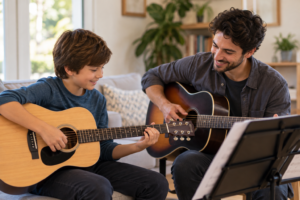
At In Home Music Mentor, personalized lessons give students an opportunity to communicate, create, make mistakes, and succeed without the pressure of a large classroom or group setting.
For a quiet or hesitant child, learning an instrument can become much more than a new hobby. It can become a way to discover confidence and a stronger sense of self.
Music Gives Children Another Way to Express Themselves
Not every child finds it easy to explain what they are thinking or feeling.
Music gives them another language.
A student can communicate energy through rhythm, emotion through melody, or personality through the songs they choose to play. They do not always need the perfect words because the music itself becomes a form of expression.
This can be especially meaningful for children who are naturally quiet in social situations.
Over time, students begin making musical choices of their own. They decide how softly or loudly to play, how to shape a phrase, or which song they want to learn next.
Those small creative decisions help children recognize that their ideas matter.
One-on-One Lessons Can Feel Safer Than a Large Classroom
For shy students, group settings can sometimes feel intimidating.
A child may understand an answer but avoid raising their hand. They may enjoy music but feel nervous performing in front of classmates. They may need more time before feeling comfortable asking questions.
Private lessons remove much of that pressure.
During one-on-one instruction, the student has the teacher’s attention without competing with a room full of other students. Questions can be asked privately. Mistakes can happen without embarrassment. Progress can happen at a pace that feels comfortable.
With In Home music lessons, students also learn in a familiar environment. Being at home can make the experience feel less intimidating, especially during the first few lessons.
Confidence Often Begins With One Small Success
Confidence rarely arrives all at once.
For many students, it starts with something small.
A child plays four measures without stopping.
They finally remember a difficult note.
They switch between two chords smoothly.
They play a song for a parent without being asked.
Each small success gives the student evidence that they are capable of learning something difficult.
That feeling matters.
A child who begins to think, “I can do this,” during music lessons may gradually become more willing to take healthy risks in other areas of life too.
Piano Lessons Can Be Especially Encouraging for Beginners
For many children, piano lessons offer an approachable introduction to music.
The keyboard provides a clear visual layout, and students can create a recognizable sound simply by pressing a key. Beginners often begin hearing musical results almost immediately.
That immediate feedback can be encouraging for students who are nervous about trying something new.
As they progress, piano students learn coordination, rhythm, note reading, listening skills, and independence between both hands.
Every new skill becomes another opportunity to experience progress.
Guitar Can Give Students a Strong Sense of Independence
Other students are drawn to the versatility of guitar lessons.
Guitar can feel especially exciting when a student recognizes chords or songs from music they already enjoy.
A child may begin with simple chord shapes and gradually become able to accompany songs independently.
Being able to pick up an instrument and play something recognizable can create a powerful sense of accomplishment.
For students who are hesitant to perform publicly, guitar can also become a personal creative outlet they can enjoy privately until they feel ready to share.
The Right Teacher Makes an Enormous Difference
A shy student may need a different teaching approach than an extremely outgoing student.
The right teacher understands that silence does not necessarily mean disengagement. Some children are processing information internally before responding.
A patient teacher gives students time to answer questions, avoids unnecessary pressure, and celebrates progress without making the student uncomfortable.
They also learn when to gently encourage the student to take the next step.
Families can explore our music mentors to learn about instructors with different backgrounds, instruments, personalities, and teaching styles.
Teacher profiles such as David B and Jada give families an opportunity to learn more about the people behind the lessons and the different approaches they bring to music education.
Music Teaches Children That Mistakes Are Safe
Fear of making mistakes can sometimes keep quiet students from participating.
Music provides a healthy environment where mistakes happen constantly.
A wrong note is played.
A rhythm gets missed.
A chord buzzes.
Then the student tries again.
Over time, students learn that mistakes are not disasters. They are information.
The teacher helps identify what happened, the student adjusts, and improvement follows.
This process can help children become more comfortable trying something even when they are not completely sure they will get it right.
Playing for One Person Can Eventually Become Playing for Many
A shy child does not need to begin by performing on a stage.
Confidence can grow in smaller steps.
First, the student plays for the teacher.
Later, they might play for a parent.
Then perhaps for a sibling, grandparent, or close friend.
Eventually, some students decide they would like to participate in a recital, school performance, choir, ensemble, or band.
Each step gives the child an opportunity to experience being seen and heard in a positive way.
The important part is allowing confidence to develop instead of forcing performance before the student feels ready.
Music Can Help Students Feel More Comfortable Being Themselves
Children sometimes become shy because they are worried about how others will respond to them.
Music gives them something personal that they can develop and take pride in.
A student may discover that they love jazz, movie soundtracks, classical music, pop, songwriting, or improvisation.
Those preferences become part of their identity.
Instead of focusing on whether they are the loudest person in the room, students can become confident in something they genuinely enjoy.
That kind of confidence often feels more authentic because it comes from ability, curiosity, and personal accomplishment.
Parents Can Encourage Confidence Without Adding Pressure
Parents play an important role in how children experience music lessons.
Encouragement can be powerful, but too much attention can sometimes make a shy child uncomfortable.
Instead of constantly asking a student to perform, parents can notice progress naturally.
Comments like “I heard how much smoother that section sounded today” or “You worked really patiently on that song” focus on effort rather than performance.
It can also help to let the child decide when they are ready to share what they have learned.
Giving students that choice increases their sense of control and independence.
Music Builds Listening Skills Too
Communication is not only about speaking.
Strong communication also requires listening.
Music students learn to listen closely to pitch, rhythm, timing, tone, dynamics, and instructions from their teacher.
They begin noticing small differences in sound and responding accordingly.
These listening habits can support children in many other settings, including school, teamwork, friendships, and family communication.
Music Can Become a Bridge to New Friendships
Private lessons may begin as an individual activity, but music can eventually connect students with other people.
A child may join school band, orchestra, choir, musical theater, a youth ensemble, or an informal group with friends.
For a shy student, shared musical interests can make social situations easier.
Instead of needing to figure out what to talk about, students already have something in common: the music.
Playing together also creates a shared goal. Students listen to one another, cooperate, and contribute their individual part to something larger.
Music Education Can Open a Much Larger World
As students become more comfortable with music, they may begin exploring opportunities beyond private instruction.
Local schools, ensembles, universities, and arts organizations help show students that music can become a lifelong interest.
Institutions such as the University of Washington School of Music, University of Wisconsin-Madison Mead Witter School of Music, University of Montana School of Music, University of Oregon School of Music and Dance, BYU School of Music, and Western Washington University Department of Music demonstrate the many paths available to students who develop a lasting interest in music.
Serving Families Across Our Music Communities
Families looking for supportive, personalized instruction can explore music lessons in Kirkland, music lessons in Madison, music lessons in Missoula, music lessons in Portland, music lessons in Provo, and music lessons in Bellingham.
We also provide personalized instruction through music lessons in Bend, music lessons in Boise, music lessons in Boulder, music lessons in Fort Collins, and music lessons in Naperville.
Families can also find local instruction through music lessons in San Diego, music lessons in San Jose, music lessons in Santa Clara, and music lessons in Raleigh.
Our teachers work with families throughout Juanita, Rose Hill, Houghton, Finn Hill, Norkirk, Totem Lake, Moss Bay, Nakoma, Shorewood Hills, University Heights, Monroe Street, Rattlesnake, South Hills, the University District, Downtown Missoula, Alberta Arts, Hawthorne, Laurelhurst, Sellwood-Moreland, the Pearl District, St. Johns, Joaquin, Maeser, Edgemont, Rivergrove, Fairhaven, Sunnyland, Columbia, Sehome, Barkley, South Hill, North End Boise, Downtown Boise, River West, Old Bend, Table Mesa, North Boulder, South Boulder, Old Town Fort Collins, Rigden Farm, Downtown Naperville, La Jolla, Carmel Valley, Willow Glen, Rivermark, North Raleigh, and surrounding communities.
Your Quiet Child Does Not Need to Become the Loudest Person in the Room
The goal of music lessons is not to change a child’s personality.
A thoughtful, quiet student can remain thoughtful and quiet while also becoming more confident.
Confidence means knowing that your ideas matter. It means being willing to try something difficult, accepting mistakes, recognizing progress, and feeling comfortable sharing something when you choose to.
Music gives children countless opportunities to practice those skills.
At In Home Music Mentor, our goal is to create lessons where students feel supported, understood, and encouraged to grow at their own pace.
If your child is curious about music but would benefit from a comfortable, personalized learning environment, visit our registration page. Tell us about your student, their interests, and their personality, and we will help your family take the next step toward finding the right music mentor.
“`