 Skip to content
Children may not have mortgages, careers, or household bills, but that does not mean their days are stress-free.
Between schoolwork, tests, friendships, sports, changing expectations, packed schedules, and constant digital stimulation, kids can carry a surprising amount of pressure by the time they walk through the front door.
For parents, the question becomes: What can help a child reset after a demanding day without simply adding another obligation?
Music can be one powerful answer.
At In Home Music Mentor, we believe music lessons can give students something increasingly valuable: dedicated time to slow down, create, focus, and make progress at their own pace.
Whether a student chooses piano, guitar, voice, songwriting, or another instrument, music can become a positive part of the week that feels different from school while still helping children develop valuable life skills.
Kids Need Healthy Ways to Decompress Too
Think about the average school day from a child’s perspective.
Students spend hours listening, following instructions, completing assignments, navigating social situations, and moving from one activity to another. After school, many still have homework, sports, clubs, or other commitments waiting for them.
By evening, it is understandable that children want to switch off.
Screens often become the easiest option. A phone, tablet, television, or video game can provide immediate entertainment with very little effort.
There is nothing wrong with digital entertainment in moderation. But children can also benefit from activities that help them actively create instead of only consume.
Music offers that balance.
Music Gives the Brain Something Different to Focus On
One reason music can feel refreshing after school is that it shifts a student’s attention.
Instead of thinking about tomorrow’s assignment or what happened during lunch, the student begins listening to rhythm, melody, timing, and sound.
The mind becomes focused on the present task.
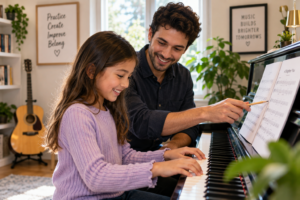
A student taking piano lessons may concentrate on coordinating both hands through a favorite melody. A student taking guitar lessons may focus on getting a chord progression to finally sound smooth.
For that moment, everything else becomes quieter.
A Creative Outlet Can Be Especially Valuable After School
Children spend much of the school day working within established rules and expectations.
Music provides room for creativity.
Students can explore different sounds, interpret songs in their own way, improvise, write melodies, experiment with rhythm, or simply play music they enjoy.
This creative freedom can help students feel that music belongs to them rather than being another assignment they need to complete.
For children who have difficulty talking about their feelings, music can also provide another form of expression.
In Home Music Lessons Can Make Evenings Feel Less Rushed
Sometimes the stressful part of an extracurricular activity is not the activity itself. It is everything required to get there.
Parents may finish work, pick up children, rush through traffic, find parking, wait through the lesson, drive home, prepare dinner, and then realize homework still needs attention.
That schedule can make even a wonderful activity difficult to enjoy.
With In Home music lessons, the teacher comes directly to the student’s home.
Families can remove one more commute from the week while students learn in a familiar environment where they may feel comfortable asking questions, experimenting, and making mistakes.
For busy parents, that convenience can make consistent music education much easier to maintain.
Music Teaches Children How to Work Through Frustration
Learning an instrument is rewarding, but it is not always easy.
Sometimes a rhythm refuses to cooperate. A chord feels awkward. A passage that sounded simple when the teacher played it suddenly feels much harder when the student tries.
These moments provide an important lesson.
Students learn that frustration does not always mean they should stop.
They can slow down, break a challenge into smaller pieces, try again, and eventually improve.
That process helps children develop resilience in a practical way.
The lesson is bigger than music: something can feel difficult today and become manageable tomorrow.
Small Musical Wins Can Change a Child’s Mood
There is something powerful about finally playing a section correctly after struggling with it.
The student can hear the improvement immediately.
That sense of accomplishment may come from learning a first song, remembering a scale, playing without stopping, or mastering a difficult transition.
Small victories give students something positive to carry away from the lesson.
After a school day filled with grades, comparisons, and expectations, simply being able to say, “I learned how to do that,” can be meaningful.
The Right Teacher Can Become a Positive Weekly Influence
The relationship between teacher and student matters enormously.
A good music teacher does more than explain technique. They learn how the student responds to challenges, what motivates them, what music excites them, and when they need encouragement.
Some students thrive with structure. Others need creativity and humor. Some love performing. Others prefer developing confidence privately before sharing their music.
Families can explore our music mentors to learn more about instructors with different instruments, personalities, musical backgrounds, and teaching approaches.
Teacher profiles such as David B and Jada help families get a sense of the people behind the lessons and the different strengths a mentor can bring into a student’s musical development.
Music Can Help Students Build a Healthier Weekly Routine
Children often benefit from having predictable activities during the week.
A regular lesson gives students something positive to anticipate. It creates a natural practice cycle and helps establish a routine around preparation and follow-through.
Practice does not need to consume the entire evening.
Short, focused sessions several times during the week can help students continue progressing without making music feel overwhelming.
A student might practice for a few minutes after a snack, before dinner, or after homework. Over time, picking up the instrument can become as natural as any other part of the home routine.
Parents Do Not Need to Become the Practice Police
One concern parents often have is whether music lessons will create another daily argument.
That does not have to happen.
The goal is not necessarily to force a perfect practice schedule. Instead, parents can help create an environment where music remains accessible and encouraging.
Keep the instrument where the student can easily use it. Celebrate improvement instead of perfection. Ask what they are learning rather than immediately asking whether they practiced.
Even better, ask them to show you something they are proud of when they feel ready.
Positive curiosity can go much further than pressure.
Music Helps Children Experience Progress They Can Hear
One unique thing about learning an instrument is that progress becomes audible.
A song that sounded hesitant three weeks ago begins flowing more naturally. Notes that once required careful thought become automatic. A chord transition becomes smoother.
Children can literally hear themselves improving.
That feedback reinforces the connection between effort and growth.
Students begin learning that improvement is not always immediate, but consistent effort produces meaningful results.
Music Can Grow With Your Child
Music is not an activity children necessarily outgrow.
A young beginner may start with simple melodies and musical games. An older student may become interested in popular songs, jazz, classical repertoire, improvisation, songwriting, recording, or performance.
Teenagers may use music as an increasingly personal creative outlet.
As students grow, their lessons can grow with them.
This makes music different from many short-term childhood activities. The instrument may become something students continue enjoying through high school, college, and adulthood.
Music Connects Students to a Larger Creative Community
Learning at home can be the beginning of a much larger musical journey.
Students may eventually explore school band, orchestra, choir, musical theater, community ensembles, local performances, or advanced music programs.
Respected institutions such as the University of Washington School of Music, University of Wisconsin-Madison Mead Witter School of Music, University of Montana School of Music, University of Oregon School of Music and Dance, BYU School of Music, and Western Washington University Department of Music illustrate just how far an early interest in music can grow.
Of course, students do not need to pursue music professionally for lessons to be worthwhile. Music can remain a source of creativity, community, enjoyment, and personal expression throughout life.
Personalized Music Lessons in Communities Across the Country
Families searching for convenient local instruction can explore music lessons in Kirkland, music lessons in Madison, music lessons in Missoula, music lessons in Portland, music lessons in Provo, and music lessons in Bellingham.
We also provide personalized instruction through music lessons in Bend, music lessons in Boise, music lessons in Boulder, music lessons in Fort Collins, and music lessons in Naperville.
Families can also explore music lessons in San Diego, music lessons in San Jose, music lessons in Santa Clara, and music lessons in Raleigh.
Serving Neighborhoods Where Families Live, Learn, and Grow
Our teachers work with students and families throughout Juanita, Rose Hill, Houghton, Finn Hill, Norkirk, Totem Lake, Moss Bay, Nakoma, Shorewood Hills, University Heights, Monroe Street, Rattlesnake, South Hills, the University District, Downtown Missoula, Alberta Arts, Hawthorne, Laurelhurst, Sellwood-Moreland, the Pearl District, St. Johns, Joaquin, Maeser, Edgemont, Rivergrove, Fairhaven, Sunnyland, Columbia, Sehome, Barkley, South Hill, North End Boise, Downtown Boise, River West, Old Bend, Table Mesa, North Boulder, South Boulder, Old Town Fort Collins, Rigden Farm, Downtown Naperville, La Jolla, Carmel Valley, Willow Glen, Rivermark, North Raleigh, and surrounding communities.
Sometimes the Best Part of a Busy Day Is Making Music
Music lessons do not remove every challenge from a child’s life.
They do, however, give students something positive to return to.
Music offers time to create instead of consume, focus instead of multitask, experiment without needing to be perfect, and experience the satisfaction of making steady progress.
For busy families, personalized lessons at home can make that experience easier to fit into everyday life.
At In Home Music Mentor, our goal is to connect students with teachers who help make music encouraging, personal, and rewarding.
If your family is looking for an activity that gives your child room to create, learn, and grow, visit our registration page. Tell us about your student, their interests, preferred instrument, and goals, and we’ll help you take the next step toward finding the right music mentor.